
Hello Nippon
(1997) The media here in Japan really loves to highlight foreigners who study intensely some aspect of Japanese culture. This NHK program: Hello Nippon, is typical of that type. It also features a segment where I visit one of the traditional printers to talk about my work and get a bit of advice ... (20 minutes ... about 28.8Mb)
TV Listings

The 'Woodblock Shimbun' has a full selection of TV programs on file. Videos available include some of David's news appearances, complete feature programs, and some short documentaries on his work. The files are in QuickTime format, and can be easily viewed with your browser.
Program listings are on the Index page ... 
Woodblock Man Carves Niche
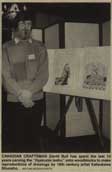
Woodblock carver David Bull refuses to be called an 'artist' or 'sensei'. "I'm just the guy who carves a piece of wood," Bull said. "All I do is copy what the real artists did." Since 1989, the Canadian university dropout who once played the flute on the streets of London has spent many hours bent over his woodblocks, nose and beard almost touching the surface, as he carved toward a self-appointed goal: the recreation of 18th century ukiyo-e artist Katsukawa Shunsho's 'Hyakunin Isshu: Poems from One Hundred Poets' series. (1999)
Full Story.
Japanese Art with a Canadian Touch
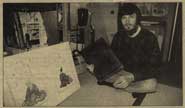
A British-born artist from Canada is holding an exhibition of his 60 works of ukiyoe woodblock prints, part of his 10-year project to carve and print the Hyakunin Isshu poem collection. (1998)
Full Story.
David Bull: Printmaker

The classic woodblock prints made famous by Hokusai and others depict a stylized, long-lost Japan. A chance encounter with woodblock printing at an exhibition in Toronto more than twenty years ago led David Bull down a path that has made him the only artist, Japanese or foreign, working to reproduce those classical prints. (2000)
Full Story.
 For comments/feedback/etc. on this newspaper, Contact David.